Quantum Computing
Quantum ML for pathogenicity prediction
Quantum machine learning offers a novel framework for modeling complex, high-dimensional biological data through quantum-enhanced feature representation.
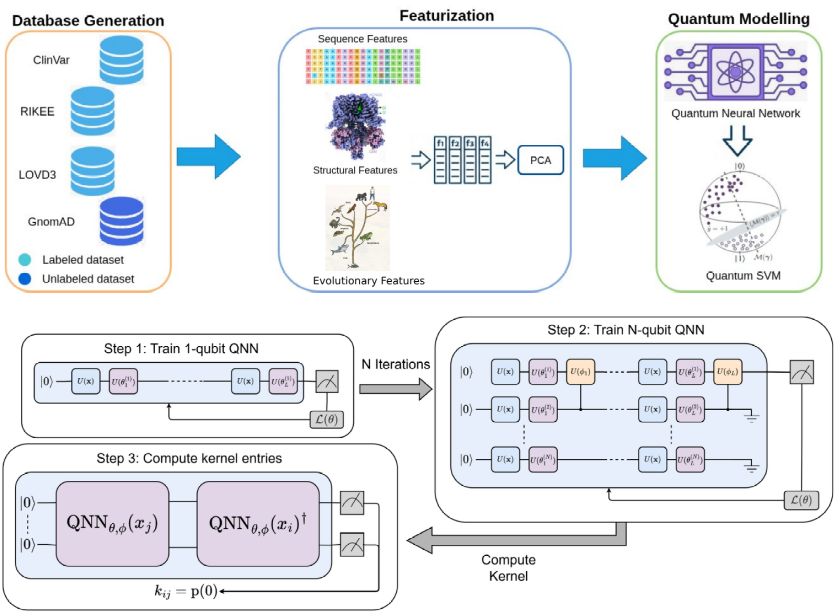
Hybrid QNN-QSVM architecture: A hybrid architecture combining QNN using data re-uploading and trained iteratively, along with an SVM using a quantum kernel derived from the trained QNN provides robust and stable training with high expressivity.
Quantum ML pathogenicity prediction performance: Despite data limitations, the quantum machine learning model matches or exceeds the performance of classical models.
Scaling potential: Great performance in the low data regime suggests that the highly expressive quantum embeddings holds great potential in this field.
Quantum Sampling of disordered proteins
Intrinsically disordered proteins: Many important proteins do not have a low energy folded state. Instead, they are characterized by an ensemble of structures.
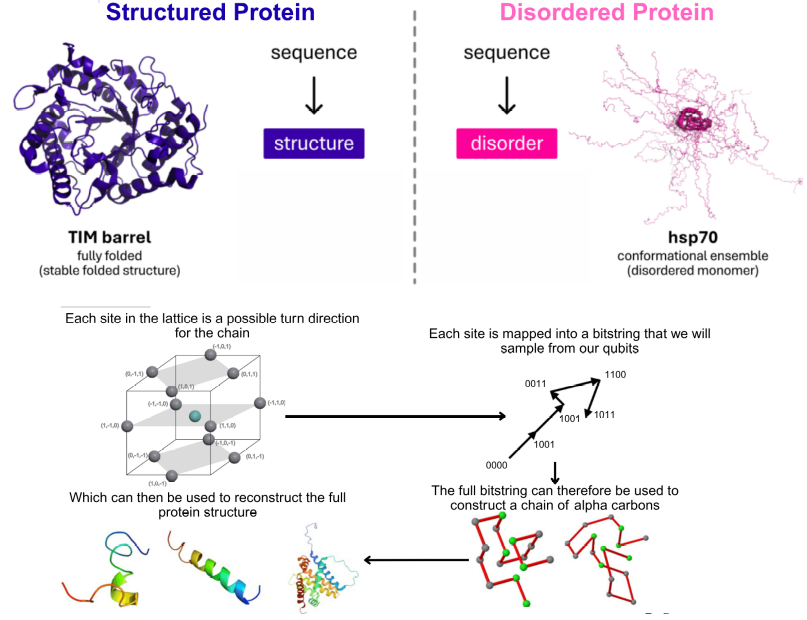
Quantum representation of protein structures: Protein structures can be represented in a quantum computer as a lattice model, where each site in the lattice encodes the position of one carbon atom.
Quantum sampling of protein ensembles: Quantum-enhanced Markov chain Monte Carlo schemes can be used to sample these quantum representations and approximate the Boltzmann distribution of these disordered proteins.